














From superpowered quirks, bizarre stands, cannibalistic titans, if you’re an anime lover, then you’ve probably seen it all, and that means you’ve likely heard of the subscription service, Crunchyroll.
Founded in 2006 at UC Berkeley, Crunchyroll began as a piracy streaming service, with most content primarily being fan-uploaded. In 2006, you were able to watch fansubbed-anime, East Asian dramas, 80s/90s flicks, and more. In 2009, Crunchyroll became a legal, legitimate, streaming service after striking a deal with TV Tokyo to stream episodes of Naruto Shippuden. Following this, the site removed any copyrighted material that they didn’t own explicit rights to stream.
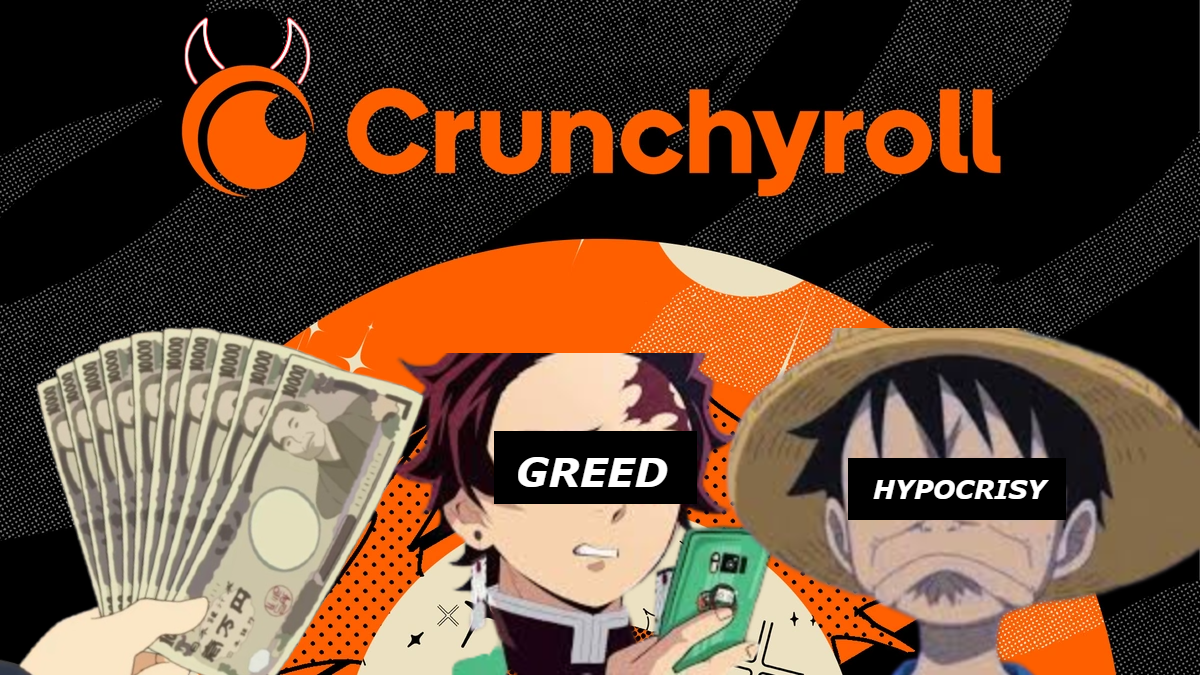
Ever since then, for years, Crunchyroll has become a dominant, mainstream, anime resource, streaming a variety of shows, ranging from My Hero Academica to Tower of God. Despite its rise to popularity, knowing its origins, you’d likely expect it to remain humble to its piracy roots. However, in modern day, Crunchyroll has only managed to relinquish its name to greed and profit.
Crunchyroll was acquired by Sony on August 9th, 2021, to which Crunchyroll soon after acquired Funimation, another anime streaming service competitor. All content and services featured on Funimation were quickly merged over to Crunchyroll, with Funimation officially shutting down in 2024.
Following the elimination of a former competitor, Crunchyroll took the monopolistic action of increasing their subscription prices in order to capitalize on the fact that they were now the primary paid-subscription service for watching anime. Many people saw this as an action characterized by selfish greed and cruelty. It was this decision by Crunchyroll that added fuel to people’s preference of using free piracy sites to watch anime, such as 9Anime, AniWatch, AnimeSuge, and more.
Though, recently, all of these notorious anime piracy sites have disappeared, leaving only the question of “Why?” Since 2025, Crunchyroll has picked up aggression in their determination to crack down on anime piracy sites in order to keep up their profits. This was also primarily due to sites like AniWatch surpassing Crunchyroll in the number of site visits, and since Crunchyroll is all about revenue these days, its natural instinct was to remove the opponent.
Crunchyroll has filed millions of URL takedown requests on sites like these. In fact, just in India alone, over 400 of these piracy domains were taken down. For free-anime watchers, this creates a variety of problems.
For one, similarly to a hydra, where one anime site falls, another copy will rise to take its place. However, copied websites tend to have several flaws or malicious features. Copied websites tend to be slow, laggy, and absolutely riddled with advertisements all across the screen. Additionally, some of these websites feature several pop-ups leading you to unlikely places on the internet where you can encounter viruses and/or explicit material.
With the lackluster quality of copied-variants of deleted websites and the fast takedowns on legitimate sites, this has led to an internet trend of “gatekeeping” on any remaining piracy sites that Crunchyroll has yet to eliminate. These days, knowing a free site where you can watch anime is the equivalent of entering a 1920 speakeasy; you must keep it secret and private only for yourself to enjoy, otherwise it’ll be busted soon enough.
It’s a shame to see a name that was once held so highly fall to the lows that Crunchyroll finds itself at. What began as a humble and praised product for youthful audiences to enjoy has fallen to corruption and corporate greed.
At the end of the day, while Crunchyroll’s actions are in an attempt to promote anti-piracy and to attract more subscribers to themselves, all they seem to be doing for the most part is angering the anime community by forcing them to now pay for something that was once freely accessible. It’s even worse when you consider how Crunchyroll was once just like these piracy sites, and now that it has become popular and official, they have turned on the very concept that helped them achieve their levels of success today, that being piracy.