



















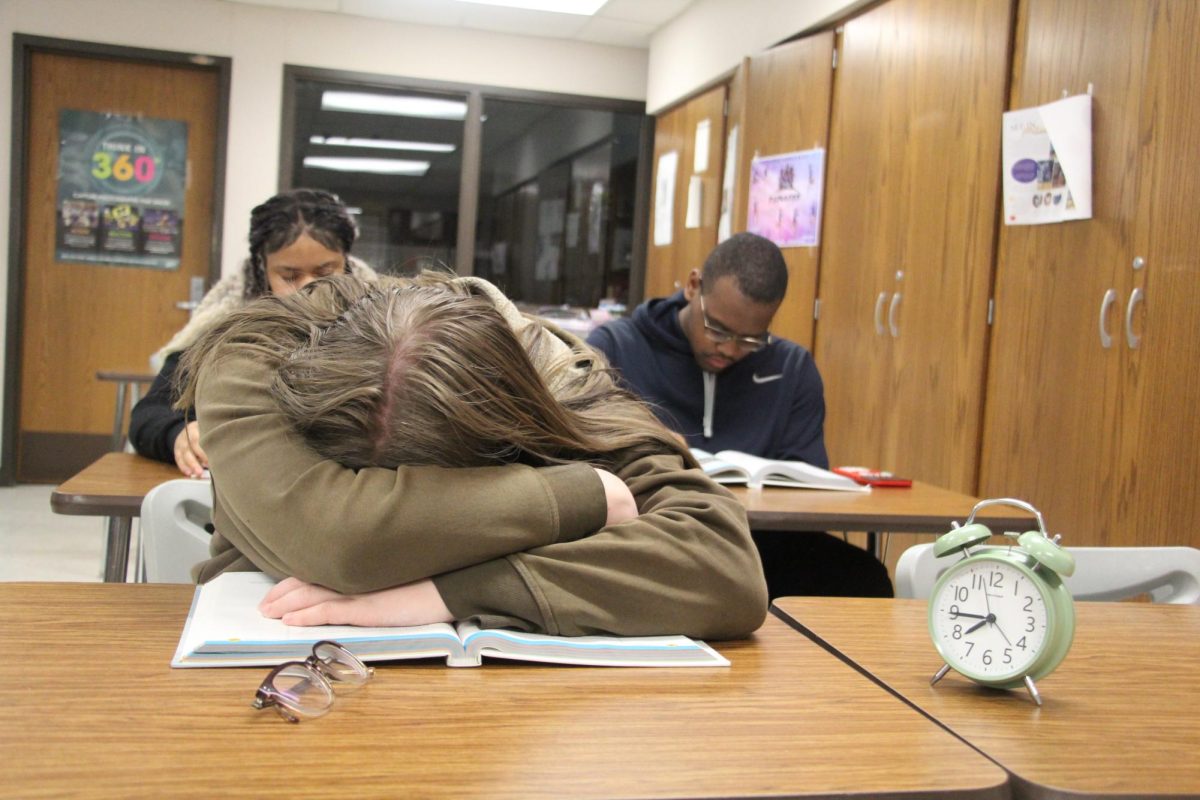
Huddled in a corner at the back of the class, head buried in her knees, using herself as a pillow is how Senior Mya Reed spent her second hour class period this morning after finishing her assignments.
“I’ve been working since I was fourteen, and they’re all different [jobs],” Mya said. “The most recent one is the most demanding job because they close at midnight. So, with that, I go there as soon as I get off of school and I’m there until 10. If I had more sleep – forget sleep, if I had more time – I would have my homework done, and then I’d be able to go to sleep…If there were like 48 hours in one day, it’d be great.”
Sleep is characterized as being one of the most important activities needed for relaxed brain activity and a core revitalization technique, and yet, many students seem to not be getting enough of it. The Center for Disease Control and Prevention (CDC) conducted a study in 2021 where they collected data from various schools in different states, monitoring how many high school students receive a healthy number of hours of sleep. Despite all results differing from each other, they all generally recorded a percentage ranging from 70%-80% of high school students reporting unhealthy sleep hours. There are numerous factors that contribute to a student’s lack of sleep, such as homework and working a part-time job. Due to this, some schools even integrate programs designed to benefit the schedules of students with jobs.
“Although the amount of sleep that an individual may need can vary (e.g., not everyone needs 8 hours of sleep per night), sleep is a time when the body can repair, rejuvenate and simply rest at the end of the day and prepare for the next day,” said MHS social worker Dr. Carol Dahlen.
Sleep deprivation will leave dire consequences that don’t just impact a person now, but it can also lead to future dilemmas.
“…Although students are young and may not feel the aftermath or downside of the lack of sleep when they’re young; not getting enough rest may affect their health and emotional health at some point. Example: not having patience with things or people, not feeling like themselves, and or making impulsive decisions.”
Mya, who is a student juggling a job, school work, and extracurriculars, hardly gets any sleep before she has to wake up for school again.
“The last time I was off was on Thursday, and that day I went to sleep at 12:30 a.m.,” she said. “I [also] had tutoring that day. My days off – I use those days because I have clubs and tutoring. The clubs go until maybe 5. I get home at about 6:30 p.m., so that’s an hour and a half, and then I still have homework, and on Wednesdays, I use those days to make up all the homework that I didn’t do the days before. So, I’ll still be up around 11 p.m. and I’ll get to sleep by 12 a.m..”
Of course, there are several factors that play into sleep deprivation beyond just jobs.
“Periodically I do hear of students falling asleep in class,” Dr. Dahlen said. “Many times it may be due to working outside of school, putting in several extra hours during the week, or for taking care of younger siblings, or having to do multiple activities after school, or rehearsals or practices. I think for many students there is a sense of being overwhelmed with all that is expected of them, and sometimes it becomes exhausting.”
As many may expect of a teenager, another factor that plays a role in sleep deprivation is social media.
“…Sometimes I just don’t want to go to bed,” said Junior Aydan Gabriel. “Sometimes I don’t feel tired. It’s just always different things. Sometimes I’m doomscrolling on Instagram or TikTok…”
Sleep deprivation has a severe effect on student academic performance in terms of attentiveness and stimulation.
“I feel like if I don’t get sleep, then I’m way less likely to have motivation to do my school work because I’d rather sleep in school than actually do work,” said Senior Noelle Elenz.
This problem worsens especially in testing scenarios.
“I can’t remember the last time I had a day off before a test, so I just stay up studying and then the test – I’m just cooked because sleep is the most important meal of the day,” Mya said. “And if you don’t sleep, you might as well just not go to school because you’re just not going to do good. It’s so bad, because you need sleep for brain function, and my brain was not functioning.”
There are some institutions that integrate programs designed to benefit students with jobs and internships. They’re commonly referred to as “work-release” programs. These programs allow students to leave halfway through the school day and earn credits depending on the amount of hours they work.
“I think [they’re] a great idea as long as it’s a pathway of your choosing, such as welding,” Aydan said. “So half a day you go to do classwork, and then the other half you go to work at a welding station or you work for construction. But if you just have a job at McDonalds, it’s kind of stupid.”
“I think [these programs] would be great,” Noelle said. “Because I feel like instead of a person who wants to be a teacher or a nurse taking a business class, they can go get an internship at a hospital or something or go get service hours if they need them.”
With lives full of responsibilities and commitments, the most important thing everyone must do, especially those as students, is to recognize self-limitations.
“…My advice or suggestion to [sleep deprived] students would be to make sure that they literally check in with themselves; that they take breaks, learn to have downtime or do nothing, to pace themselves and recognize when they’re over extending themselves,” Dr. Dahlen said. “Also, most important, be sure to keep up the nourishment, the water intake, the quick healthy snacks and at least one complete meal each day.
“Life can be challenging and not everything is in our control, so we try to find at least some balance with activities and school so we don’t feel like we’re running on empty most of the time. Take care of yourself as best you can and what’s within your control.”